


Most companies don’t fail at data because they lack data.
They fail because data is hard to consume.
Someone asks a simple question (“Can I get the sales dataset?”) and suddenly you’re stuck in a mess of files, copies, permissions, unclear ownership, and the classic: “Is this the latest version?”
That’s what a data product fixes.
A data product is just data packaged in a way that makes it usable:
people can find it
people can access it without drama
people know what it is and what it’s for
it behaves like something you deliver, not something you dump
Now, the elephant in the room.
“Oracle = lock-in”… does it have to?
A lot of people still have that perception. Sometimes it’s based on old experiences. Sometimes it’s just a story that stuck.
What’s changed is that today you can deliver data through open protocols and very standard interfaces: shares, a marketplace, links, and APIs. If the way your consumers interact with your data is standard, the lock-in fear drops fast.
In Autonomous AI Lakehouse, these 4 features are basically 4 different “delivery shapes” for a data product:
A share for partners and tools (Data Sharing / Delta Sharing) Oracle Docs
A catalog listing for internal discovery (Data Marketplace) Oracle Docs
A secure link for fast, controlled access (Table Hyperlink) Oracle Docs
An API for applications (ORDS REST services) Oracle Docs
1) Data Sharing (Delta Sharing)
The business problem: you need to share a dataset with multiple external parties (customers, partners, agencies, vendors), and the “export files and email them” approach creates chaos: duplicates, old versions, manual work, and zero trust.
With Autonomous, “versioned” data sharing for general recipients is based on the open Delta Sharing protocol, exposed as a REST API, and data is delivered in Parquet (efficient for analytics).
Each recipient gets a personal activation link to download a JSON profile with what they need to access the share.
This is built for repeatable distribution at scale: one provider, many recipients, standard protocol, and a clear “publish a dataset” model.
If you need “near real-time” inside the Oracle world, Autonomous also supports Live Shares (but those are consumed using cloud links and can only be consumed in an Oracle database).
This solution is also very used when sharing data between 3rd party data lakes and Autonomous AI Lakehouse.

2) Data Marketplace
The business problem: inside the company, teams lose time because they don’t know what data exists, don’t trust it, or don’t know who to ask. That leads to duplicated datasets, duplicated pipelines, and slow decision-making.
Data Marketplace is part of the Data Studio suite. It’s a place where producers publish datasets as listings (with descriptions, tags, documentation links, and target audience), and consumers can discover them and then load/query the data for their needs.
It’s also designed for business users and data teams to work with shared datasets, and the listing can show a statistical profile of the dataset.
This is not “data delivery to the outside world”. This is internal productization: making data easy to find and reuse across teams, with a marketplace-style experience. It’s how you reduce the “who owns this table?” tax.

3) Table Hyperlink
The business problem: sometimes you need to share data fast, but you don’t want to create accounts, open network access, or build an integration just to satisfy a short-lived request (audits, incident response, partner reporting, a one-off review).
A Table Hyperlink is a controlled URL that provides access to tables, views, or even the result of a SQL query. You can set it to expire by time or by number of uses, allow access from the public internet even if the database is in a private subnet, and add IP-based ACL checking. You can also use Table Hyperlink Groups to expose multiple tables through a single link.
This is the “fast delivery” tool. A hyperlink is perfect when you want temporary, controlled access with minimal setup. It’s explicitly positioned for emergency access, third-party audits, B2B sharing, and even “data as a product” scenarios where the link expires after access.
Table Hyperlink data can be viewed in tabular format when accessed from a browser. The table format supports scrolling, sorting, filtering, cell colors, and Group By where you select a column name to see column data based on the values in the column.
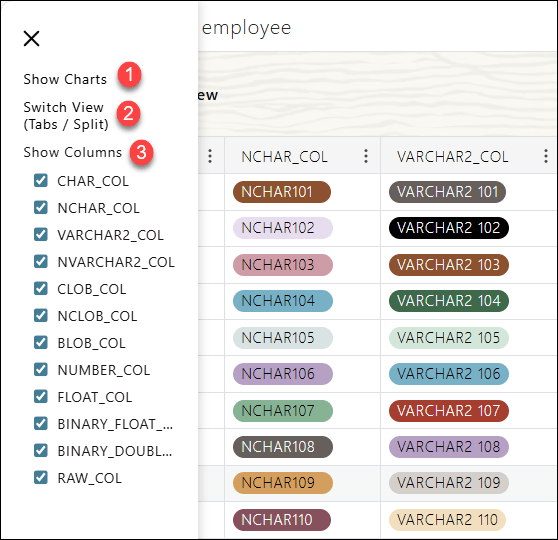
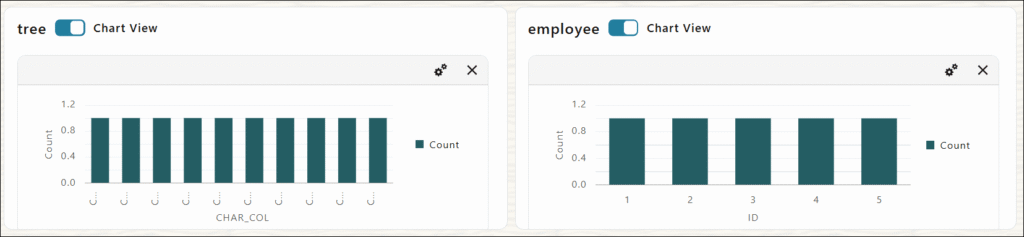
Also it is possible to create custom charts, just using the URL provided by the Oracle Autonomous AI Lakehouse
4) REST services (ORDS)
The business problem: when the consumer is an application (not an analyst), “a table” isn’t a product. Apps want stable endpoints: “give me customer profile”, “create an order”, “update status”.
ORDS maps HTTP verbs (GET/POST/PUT/DELETE) to database transactions and returns results as JSON.
In Autonomous, ORDS is preconfigured and fully managed, it connects using the low service with a fixed max number of connections, and the default configuration can’t be changed (with an option for customer-managed ORDS when you need flexibility).
This is “data product as an API contract”. It’s not about sharing a dataset; it’s about powering software with governed, database-backed endpoints.

When to use what: a simple comparison
| Feature | Use it when… | Who consumes it? | What you’re delivering | Best business outcome |
|---|---|---|---|---|
| Data Sharing (Delta Sharing) (Oracle Docs) | You need to share datasets with external parties or tools, repeatedly, at scale | Partners, customers, external tools that support the protocol | A share (standard protocol, REST-based, Parquet) | Less manual exporting, fewer copies, more trust in “the dataset” |
| Data Marketplace (Oracle Docs) | Your biggest pain is internal discovery and reuse (“where is the right dataset?”) | Internal teams (business + data) | A listing/catalog entry with context + access path | Faster delivery inside the company; less duplication; clearer ownership |
| Table Hyperlink (Oracle Docs) | You need fast, controlled, temporary access without onboarding users or building integrations | Auditors, partners, reviewers, internal rapid-response needs | A secure link with expiration and controls | Speed + governance; perfect for audits/incidents/one-off data delivery |
| ORDS (REST services) (Oracle Docs) | An application needs the data (or needs to write back), and you want a stable interface | Developers, apps, integrations | An API (HTTP + JSON, CRUD-style patterns) | Cleaner app integration; fewer data copies; clearer contract for consumers |
Here’s the Autonomous part people miss: you don’t “build” data products with glue code and endless tickets. You publish them. Same place, same security, same governance. Share it, list it, link it, or expose it as an API and move on. That’s what Autonomous buys you: less plumbing, fewer excuses, faster delivery.